Editor v4: The future of Elementor in 2025 and beyond

I am absolutely thrilled to see how far Elementor has come. Since it launched in 2016, it has completely changed how we build for the web. What started as a simple drag-and-drop tool has grown into a powerhouse for professional creators.
Why did the change happen?
The web didn’t stay still, and neither did Elementor. Their transformation was sparked by three big shifts:
- Modern CSS: The arrival of Flexbox and Grid changed the game.
- Healthy competition: Bricks and Oxygen pushed the boundaries of what’s possible.
- Community pioneers: Educators like Ooohboi showed the community new ways to push the code.
The container revolution
The move to Flexbox Containers was a massive milestone. It wasn’t an overnight shift, but a steady journey toward better performance.
- March 2022: Flexbox Containers arrived as an alpha experiment
- October 2022: The feature moves to beta
- February 2023: We got the Release Candidate
- September 2023: Containers became stable
- Today: We have entered the Version 4 era with atomic elements!
The journey: Finding balance
Think of Elementor’s growth like learning to ride a bike.
- The training wheels (Sections and Columns): Elementor did the heavy lifting. It managed the “wrappers” and CSS for us. All we had to do was set a few widths and go.
- Taking the stabilisers off (Containers): We gained more control over flexbox styles, but we still had extra code (divs) holding us up.
- Advanced cycling (Grid and Nested Elements): They added more complexity and freedom to lay out elements
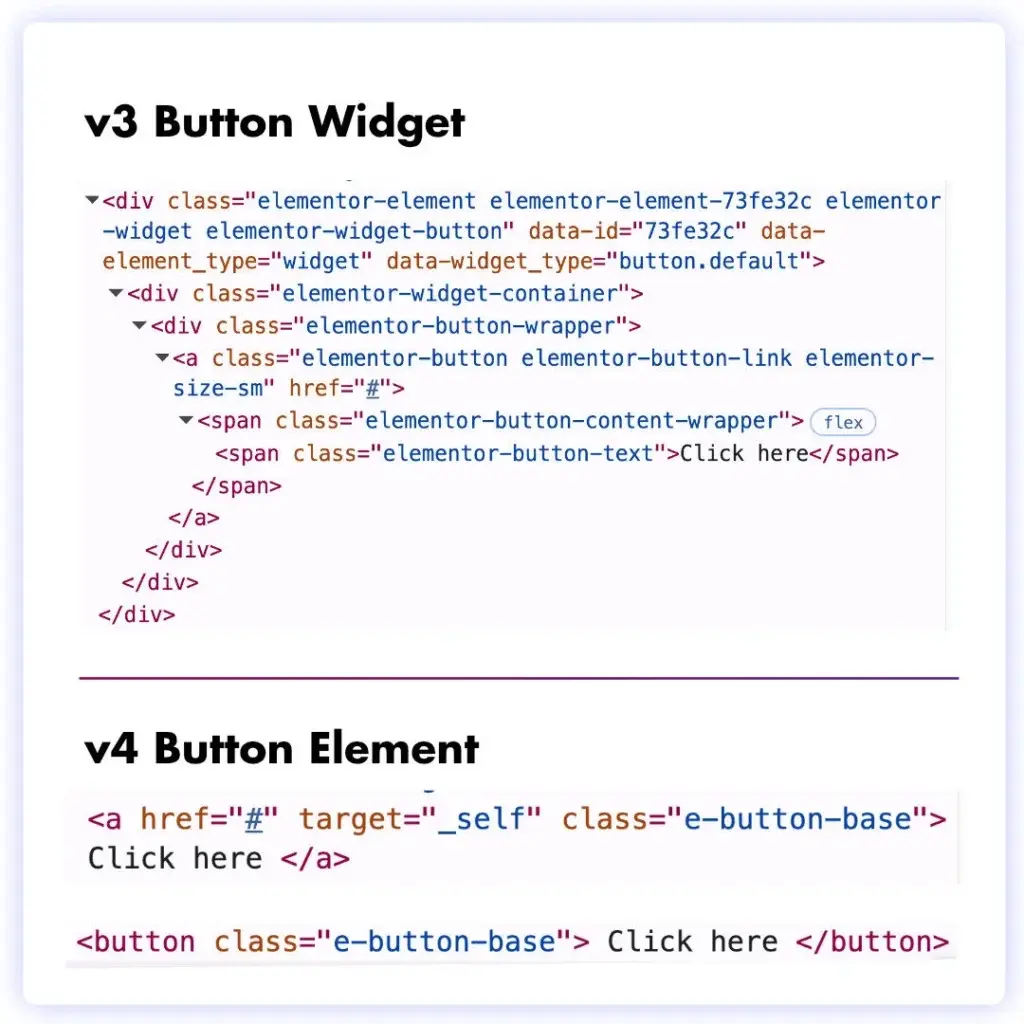
- Riding solo (Atomic Elements): The training wheels are gone! We’ve reached the “Atomic” era. No more hidden CSS or unnecessary wrappers—just direct, raw power.
Direct HTML: A total game-changer
In the past, adding a heading meant your code was buried under layers of “wrapper” divs. These were meant to help with margins and effects, but they added bloat.
Now, you have direct access to the root element. If you place an <h2> heading element, you are working with that <h2> directly. It’s faster, cleaner, and much more professional.
Why “Atomic” elements win:
- Leaner code: Less HTML means your sites load faster
- Easter updates: Use global classes and variables to style your site in seconds.
- Better accessibility: It’s now much easier to see your HTML structure. You can add ARIA attributes directly to the root element, making your sites more inclusive for everyone.
What’s next?
This is just the start of a brilliant new chapter! As Elementor builds on this new foundation, your voice matters more than ever.
Join the movement: If you find a bug or have a great idea, head over to GitHub and let the Elementor team know. Let’s work together to make WordPress and web development better for everyone!
Comments
No comments yet — be the first.
Leave a comment
Replying to .
Thanks — your comment is in
It's awaiting moderation and will appear after it's approved and the site is rebuilt.